Attaché Case: What It Is, and How It Differs From a Briefcase
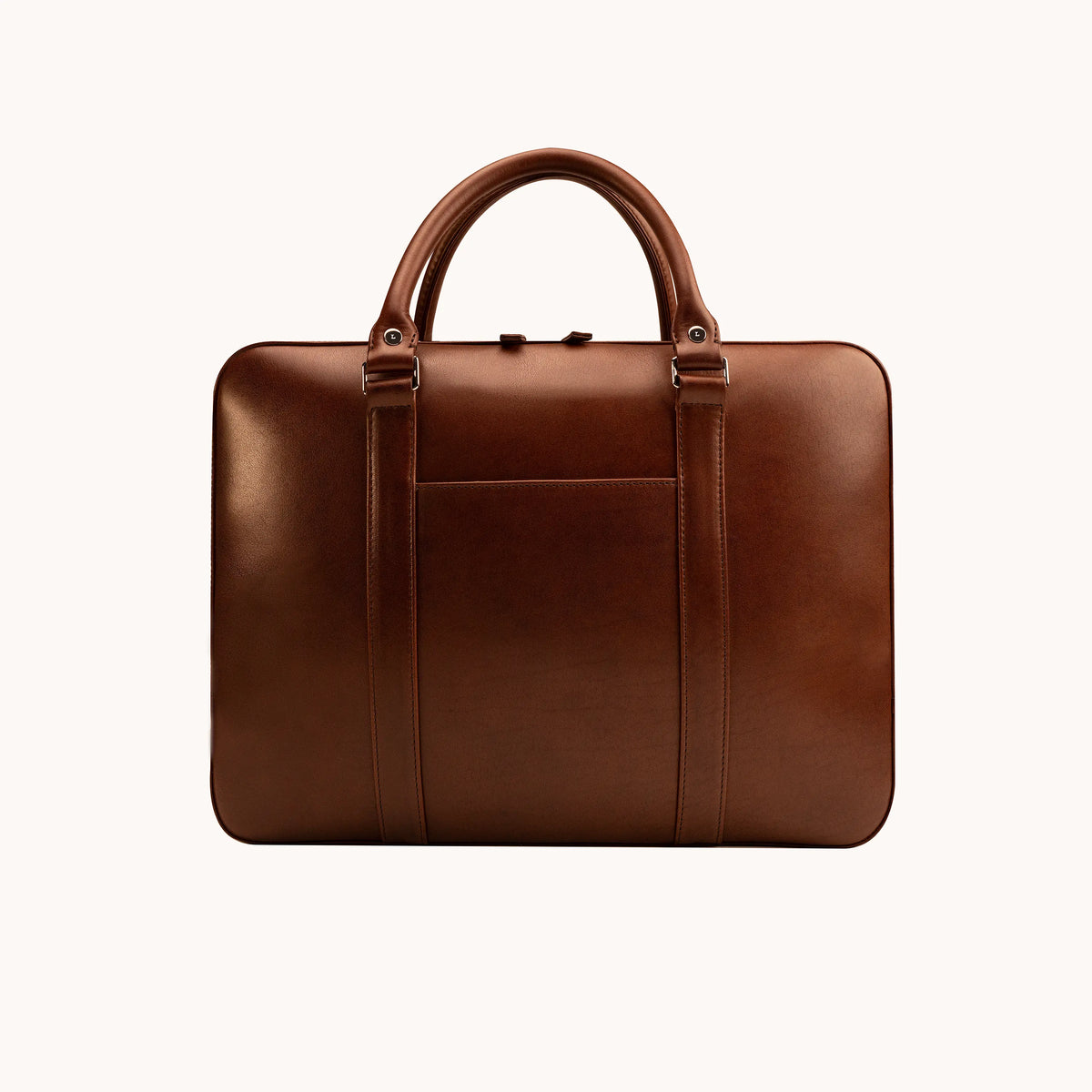
An attaché case is a slim, rigid, hard-sided case built around a frame, opening flat like a clamshell into two shallow compartments. It carries documents and very little else, and it holds its shape whether it is full or empty.
That rigidity is the whole distinction. A briefcase is a category. An attaché is a briefcase with a frame.
What "attaché" means
The word is French and it means attached. It described a junior officer attached to the staff of an ambassador, and it entered English in the first half of the nineteenth century. The reference works of record disagree on exactly when, giving dates ranging from the early 1820s to the mid 1830s, and that spread is itself worth knowing: it means the word arrived gradually through diplomatic usage rather than at a single moment.
The case came much later. "Attaché case", meaning a small leather case for carrying papers, is recorded around 1900.
So the object is named after the person who carried it, some seventy years after the person acquired the title. It is a diplomat's case, and it was designed for documents that had to arrive flat and in order.
Attaché case versus briefcase
| Attaché case | Briefcase | |
|---|---|---|
| Structure | Rigid frame, hard sides | Soft, semi-rigid or structured |
| Opening | Clamshell, flat, both halves usable | Top flap, zip, or a divided opening |
| Depth | Slim and fixed | Often expandable |
| Capacity | Documents, a laptop at most | Varies widely |
| Shape when empty | Unchanged | Collapses or slumps |
| Closure | Latches, often combination locks | Buckles, zips, turn locks |
| Formality | The most formal case there is | Ranges from formal to casual |
Every attaché case is a briefcase. Most briefcases are not attaché cases.
The practical difference is what happens when you set it down. An attaché stands and stays open flat on a table, both halves presenting their contents. A soft briefcase folds around what is in it.
What a briefcase is, and why it is called that
A briefcase is a flat case for carrying documents and working materials by hand. The name comes from the brief, the written summary of a legal case that a barrister carried to court, and the bag took its name from its most important cargo.
That origin explains the proportions. A briefcase is shaped by paper, which is why the dimensions have barely changed while everything inside them has.
Attaché case versus valise
A valise is a small travelling bag, soft-sided, for clothing and personal effects on a short journey. It shares nothing structurally with an attaché beyond being carried by hand.
The two get compared because both are old words for handheld luggage. In use they are opposites: one is rigid and holds documents flat, the other is soft and holds whatever you push into it.
The anatomy of an attaché case
The parts of an attaché are what separate a good one from a poor one, and none of them is visible in a photograph.
The frame is the defining component, usually metal, running around the perimeter of both halves. It is what gives the case its rigidity and its ability to close precisely, and it is the hardest and most expensive part to make well.
The shell is built onto the frame, and the join between the two is where a badly made case fails first.
The corners take every knock the case receives and are usually reinforced.
The top handle is centred so the case hangs level, and its anchor points carry the entire loaded weight through a small area.
The latches, often with combination locks, must align exactly, and misalignment is the most common complaint on a case that has aged.
The depth is deliberately shallow, and the gusset is fixed rather than expanding, because an attaché is designed to hold documents flat and not to swallow more than it should.
What an attaché case is used for today
Documents, a slim laptop, the things a meeting requires and nothing more.
The archetype survives where formality still means something, and it has been displaced almost everywhere else by soft cases that carry more and weigh less. What it retains is presence: an attaché makes a statement no soft bag makes, and that is now most of the reason to own one.
The modern constraint is the laptop. The traditional slim depth was set by paper, and a laptop plus a charger asks for more room than a strict attaché profile allows. Anyone buying one to carry a laptop should check the internal depth against the actual machine rather than assuming.
How to choose an attaché case
Start with the frame. Ask what it is made of and how the shell is joined to it. A maker who cannot answer has not made the case.
Check the internal depth against what you actually carry, measured rather than described.
Look at the corners and the handle anchors. These are the two failure points, and how they are reinforced tells you how long the case is expected to last.
Ask about the leather in the usual four ways: which layer of the hide, which part of the animal, how it was tanned and over how long, and what finish. A structural panel on a rigid case wants full grain from the bend, with real thickness.
Handle the latches. They should close with a definite action and align without persuasion.
Related reading
Types of leather · Leather patina · Dopp kit · Holdall · Saddle stitch
Read more

Nappa Leather: What It Is, and Where the Name Comes From
A soft, fine-grained leather produced by an approach to tanning rather than by a grade or a finish.
Read more
Types of Leather: The Full Guide
Leather is described in four ways at once, and almost every argument about leather types comes from collapsing them into one.
Read moreExplore our Folded Edge Creations