Holdall, Duffel or Duffle: What the Words Mean
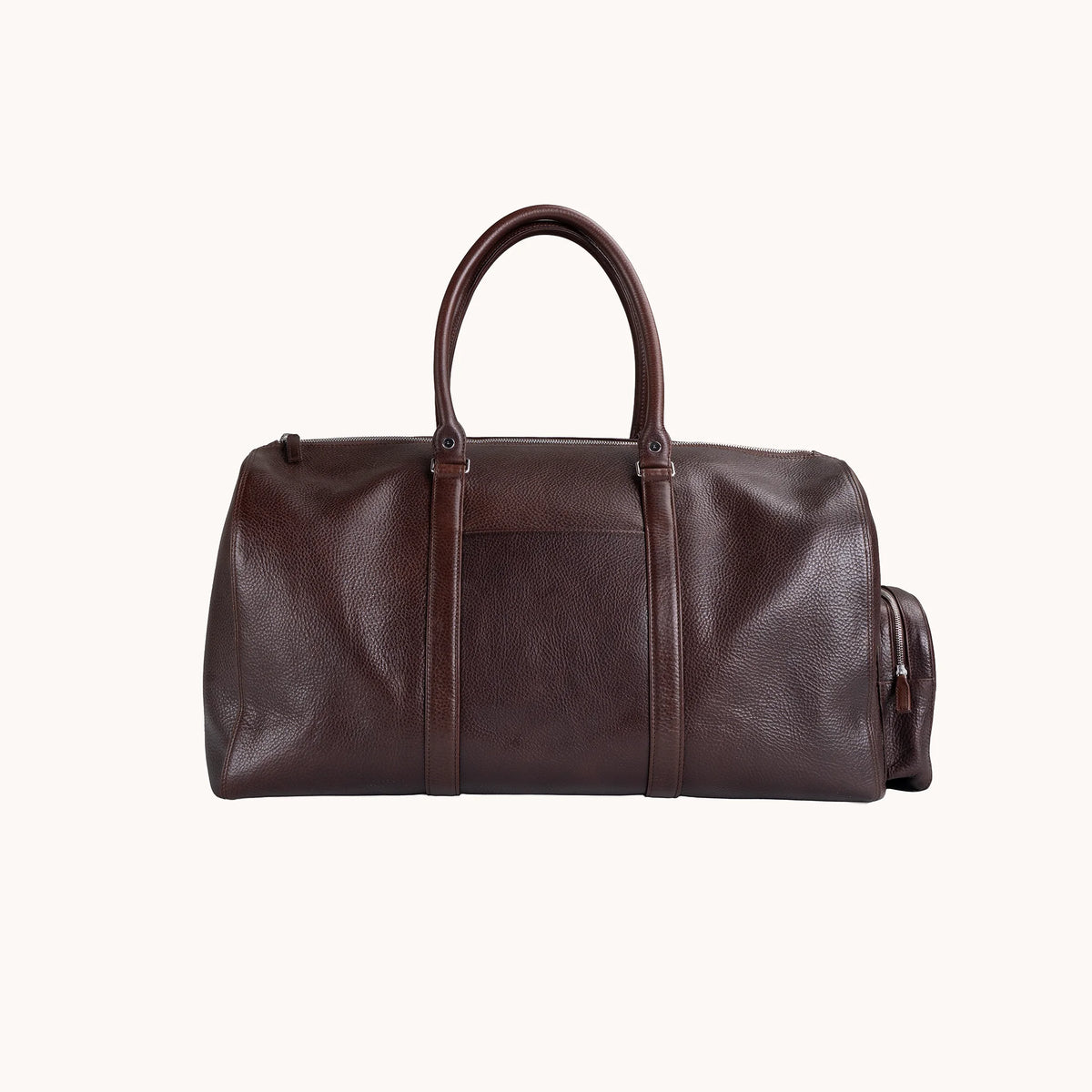
They are the same bag. A soft, cylindrical or squared-off travel bag with a wide opening along the top, carried by handles or a shoulder strap.
Holdall is what it is called in Britain. Duffel and duffle are what it is called in America, and both spellings are correct.
Duffel or duffle: which spelling is right?
Both, and the history explains why.
The word came into English from Dutch, and it is a place name. Duffel is a town in Brabant, now in the province of Antwerp in Belgium, where a coarse, heavily napped woollen cloth was made and traded for centuries. The cloth took the name of the town, and English adopted it in the seventeenth century.
So the place has one l, and the older English spelling follows it. The two-l form arrived later as an English variant and is now thoroughly established, particularly in the United States.
If you want the strictly historical form, use duffel. If you use duffle, you are in the good company of most of the dictionaries and most of the market. What you should not do is treat either as an error.
What is a duffel bag?
A duffel is a soft bag, longer than it is tall, opening along the top rather than at one end, without internal structure. It collapses when empty and takes whatever shape its contents give it.
That is the whole design, and its virtues follow from it. It packs more than a structured bag of the same nominal size because there are no rigid walls, it stows flat when not in use, and it tolerates being overfilled in a way a framed case does not.
The corresponding weakness is equally direct. It offers no protection to what is inside, and it will not stand up on its own.
Duffel, holdall and weekender: the same bag, different words
| Term | Where used | What it implies |
|---|---|---|
| Duffel, duffle | United States | Soft, top-opening, travel or gym |
| Holdall | United Kingdom | The same bag, usually smarter in tone |
| Weekender | General | A holdall sized for two or three nights |
| Kit bag | United Kingdom, military | The original service duffel |
| Gym bag | General | The same shape, smaller, sports use |
The distinctions are regional and tonal rather than structural. A holdall in a British shop and a duffel in an American one are the same object with different signals attached: holdall reads slightly more formal, duffel slightly more utilitarian.
Weekender is the only one that says anything about size, and it says it loosely: enough for a short trip.
Why it is called a duffel bag
Because it was made of duffel cloth.
The bag is named for its material, and the material is named for the town that made it. The cylindrical top-opening bag with a drawstring became standard military kit, which is where the name entered general English, and the shape has survived long after the cloth was replaced by canvas and then by leather and synthetics.
On the dates, the reference works disagree, which is common with words that moved through military use before reaching print. The bag sense is recorded in American English in the early twentieth century, while the Oxford English Dictionary records the phrase considerably earlier. Both are reported here rather than choosing one.
What duffel bags are used for
Travel, principally, and the format has outlasted almost every alternative for a reason: for soft luggage of a given size, nothing carries more.
It is the wrong bag for anything that needs protecting, and the wrong bag for documents, which want to arrive flat. For clothing on a short trip it remains the most efficient shape anyone has devised.
What separates a good one is not the shape but the points that take the load. The base, which meets every floor it is set on. The handle anchors, which carry the entire weight through a small area. The zip, which is asked to close over an overfilled bag. Those three fail long before the panels do, and they are where a leather holdall earns its price or does not.
Related reading
Read more

Saffiano Leather: What It Is, and How It Is Made
A finish rather than a hide or a grade: a cross-hatch pressed into the surface with a heated plate.
Read more
Aniline Leather: What It Is, and How to Tell
Coloured with transparent dyes and then left alone. The surface you touch is the leather itself.
Read moreExplore our Folded Edge Creations