Types of Leather: The Full Guide
Leather is described in four ways at once, and almost every argument about leather types comes from collapsing them into one.
Which layer of the hide it came from. Which part of the animal it was cut from. How it was tanned. And what was done to the surface afterwards. A single piece of leather has all four, and they are independent: a full grain can be cut from the belly, chrome tanned in a day, and finished to look like anything at all.
Most guides cover the first and ignore the rest. The tanning question decides the most and is mentioned the least: vegetable tanning takes around forty days and produces a firm leather that can develop a patina, while chrome tanning does the job in about one and produces a leather that never will. Roughly nine tenths of the world's leather takes the fast route.
How many types of leather are there?
There is no settled number, and anyone who gives you one has chosen it.
When people say there are five types of leather they mean the familiar ladder: full grain, top grain, genuine, split, bonded. Longer lists of eight or ten add nubuck, suede, patent and the rest. Those are not further rungs. They are things done to a surface, and a nubuck can be full grain, and a patent can be a split.
That is why the number moves. The lists are answering different questions at the same time.
A word about the words
The names on that ladder are trade language. They came from the tanning and leather trades, they are used with reasonable consistency, and they describe something physical and real. What they are not is a set of categories anyone is examined against. No one grades a hide the way a diamond is graded.
So when you read "top grain" on a label, you are reading a description offered by the seller. Usually an honest one. But the term is doing descriptive work, not certifying anything.
The exception worth remembering is bonded leather, because two products carrying that name can be almost entirely different materials.
Part one: which layer of the hide
A hide is not the same material all the way through. Its outer face, the grain, is dense and tightly fibred because it had to be. Go deeper and the fibres loosen and open out.
| Grade | Where it comes from | Its surface | How it behaves |
|---|---|---|---|
| Full grain | The outer layer, whole | The animal's own, marks and all | Strong, and the only grade that truly patinas |
| Top grain | The outer layer, sanded | Buffed smooth, refinished, often printed | Even and predictable; loses the natural grain, not the strength |
| Genuine leather | Any layer, usually lower | Heavily finished | Anything at all. The word does not narrow it |
| Split | Beneath the grain | No natural grain; made into suede or coated | Softer, weaker, never patinas |
| Bonded | Leather fibre bound onto a backing | Printed or coated | Lifts and flakes; not a hide in any meaningful sense |
Full grain leather
Full grain is the complete outer surface with nothing taken off it. The pattern you see is the animal's own life: growth lines, insect marks, the occasional scar. It is the densest material a hide will give you, and the only one that develops a true patina, because the surface doing the ageing is the surface the animal grew.
It is also unforgiving. Nothing can be hidden, so full grain has to come from a good hide, and good hides are the minority.
Top grain leather
Top grain is that same outer layer with the very face abraded away, usually to take out marks, then refinished and often embossed with a grain pattern. It is more even than full grain, more predictable to cut and sew, and a great deal of very good leather work is made from it.
What is given up is the top few tenths of a millimetre, and with it the hide's own grain pattern and any possibility of a patina.
A confusion worth clearing up, because it is repeated everywhere. You will read constantly that top grain is weaker than full grain because the strongest fibres have been sanded off. That is not right. A hide's tensile strength comes from the corium, the thick layer of interwoven collagen beneath the grain, and that layer is untouched by correcting a surface. Taking a fraction of a millimetre off the top of a 2 mm hide does not meaningfully weaken it.
What correcting the surface actually costs is different, and it matters more:
- The natural grain is gone. What you see afterwards is a printed or sprayed replacement.
- Patina becomes impossible. The surface that would have responded to light has been removed and sealed over.
- Abrasion resistance changes. The tight natural grain is a good wearing surface; a finish is a different material with a different lifespan.
And this is the part that matters most, because the logic runs opposite to the way it is usually told.
The cleanest hides are the ones sold full grain and unfinished. A hide with few scars, no brand marks, little insect damage and no healed scratches can be sold exactly as it comes, because there is nothing on it that needs hiding. Those hides are the minority of any batch, and they command the highest price for precisely that reason.
Hides carrying marks cannot be sold that way. Sanding takes the defects off, and a printed grain and a pigment coat put a surface back. That is what correction is for, and it is the only reason anyone does it.
So a hide is not made lesser by being sanded. It was sanded because it was already the lesser hide. Full grain is not a process that improves leather. It is what a tannery is able to do only when the hide was good enough to begin with, and the marks you can see on a full grain surface are the proof that nothing was taken off to hide anything else.
That is the honest case for full grain. Not that top grain will snap, but that full grain is evidence of the hide underneath it.
What is not given up is durability of the surface finish. Whether a finish eventually lifts is a question about the finish, not about the grade underneath it. A poor finish on full grain will peel. A good finish on top grain will not. We say this because the opposite is repeated constantly, and it is simply wrong.
Genuine leather
"Genuine leather" is the term that causes the most damage, because it sounds like a promise and functions as a floor. It confirms the material is leather rather than plastic. It says nothing about which layer, how much coating, or how long it will last.
It is the least informative true thing a maker can say about a piece of leather.
Split leather
Thick hides are separated into layers. The lower layers are splits. They have no grain surface, so they are either buffed into suede or given a coating with a pattern pressed into it.
None of that makes split leather bad. It is the right material for plenty of work. It simply will not do the things a grain surface does, and it will not age into anything.
Bonded leather
Bonded leather is leather fibre, ground down and mixed with a binder, then laid onto a backing. It is to leather what chipboard is to a plank. If a seller cannot tell you the proportion of actual leather fibre in it, you have not been told what you are buying.
Part two: which part of the hide it was cut from
This is the axis nobody publishes and every maker cares about. Two pieces can both be honestly described as full grain and behave completely differently, because they were cut from different parts of the same animal.
A hide is not uniform across its area any more than it is through its thickness. Fibre density, direction and consistency vary enormously from the spine outwards.
| Cut | Where on the animal | Fibre character | What it is right for |
|---|---|---|---|
| Bend, and the double-bend core | Along the spine, the back and rear | Densest and most uniform; fibres run consistently | Structural panels, belts, anything that must hold its shape |
| Shoulder | Front of the animal, above the forelegs | Firm, but marked with growth wrinkles | Tooling, smaller goods, where character is wanted |
| Belly | The lower sides | Loose, open, stretchy, uneven thickness | Linings, straps of little consequence, filler |
| Neck | Front, above the shoulder | Coarse, wrinkled | Small parts, offcuts |
The bend is the prize. The strip either side of the spine has the most uniform fibre structure in the hide, and the double-bend core, the section running along the spine itself, is the most consistent part of that. Leather cut from there holds architectural form without distorting. Leather cut from the belly will not, however good the grain looks when new.
This is the single most useful thing a buyer can learn about leather, and it is almost never disclosed. A bag can be made entirely of full grain and still sag within two years, because the panels were cut from belly.
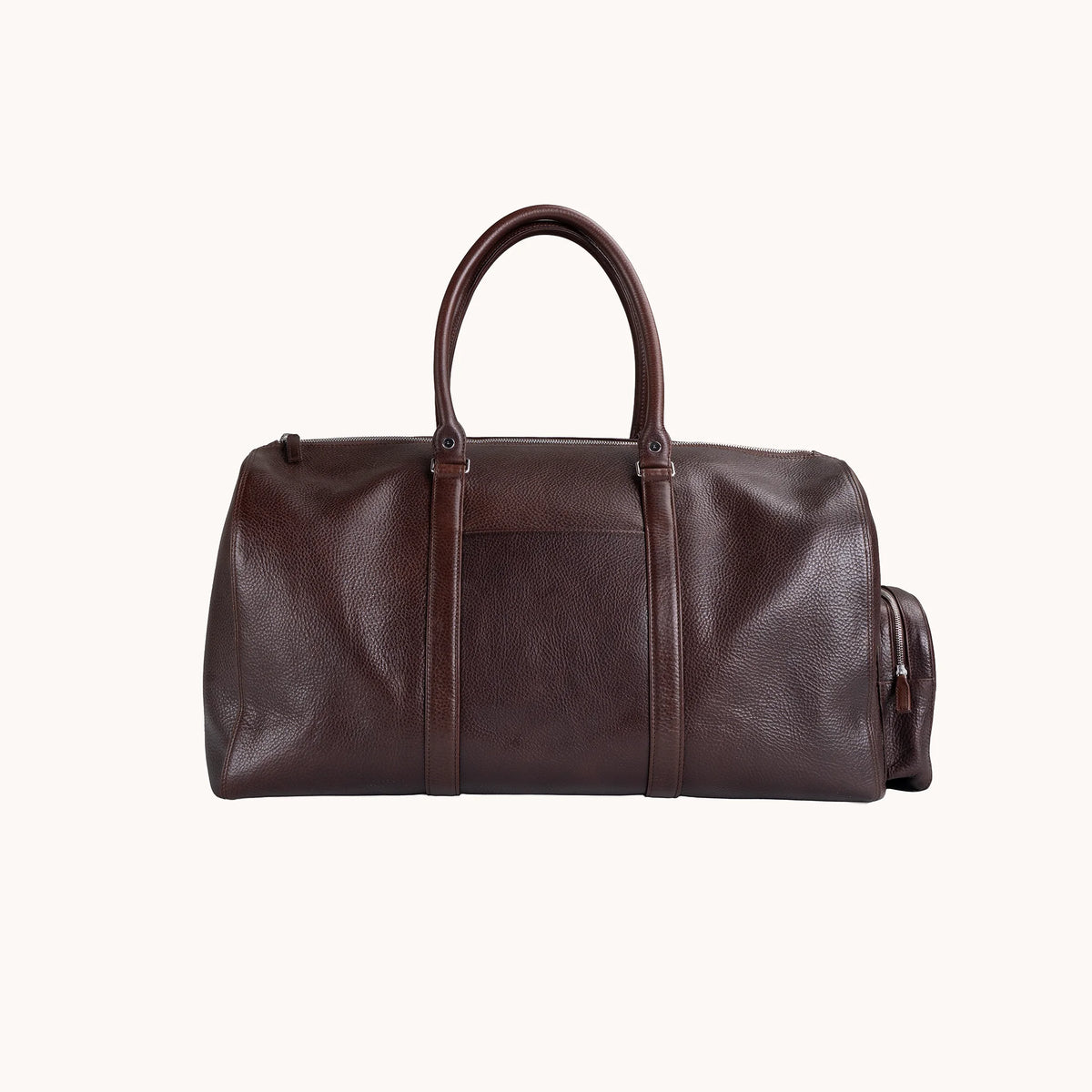
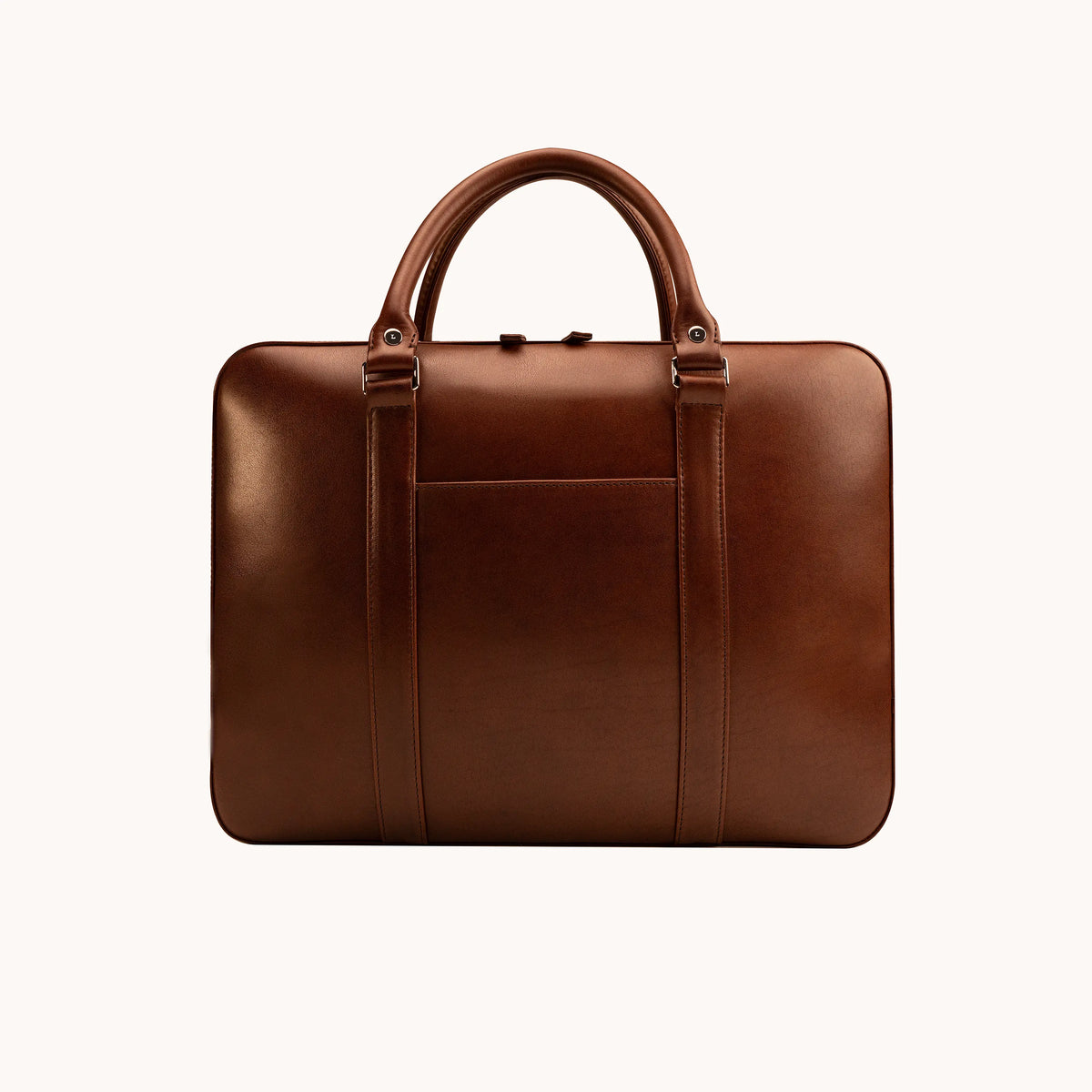
At Lunburg, Perpetual Leather is selected only as full-grain vachetta from the double-bend core, at 2.0 mm, precisely because that structural memory is what a briefcase panel needs and what a belly cut cannot supply.
Thickness
Thickness is measured in millimetres and it is the other half of this question. A 2.0 mm panel and a 1.2 mm panel of identical leather are different materials in use. Heavier is not automatically better, since a wallet at 2.0 mm would be unusable, but a structural panel below about 1.6 mm will not hold a shape over years.
Part three: what was done to the surface
These are not grades and not cuts. They are treatments, and each can sit on almost any grade.
How it was coloured
Aniline leather is dyed through with transparent dyes and left with no pigment layer on top, so the grain and all its markings stay visible. It is the most honest surface and the least protected: it marks, it absorbs, and it patinas. It is only used on hides good enough to show.
Semi-aniline is aniline dyed with a light pigment coat added over it. A compromise, and often a sensible one: most of the natural grain still reads, with some resistance to staining and fading. Most quality furniture leather is semi-aniline.
Pigmented leather carries a full opaque pigment layer. The surface you see and touch is the coating rather than the hide. It is the most uniform, the most stain resistant and the most durable in a hard-use sense, and it will not patina because the leather is not exposed. Nearly all automotive leather is pigmented.
How it was finished
Pull-up leather is aniline leather heavily charged with oils and waxes. When it is pulled, folded or flexed, the oils move away from the stress and the colour lightens at that point, producing the characteristic mottled, lived-in look. Scuffs largely rub out because the oils redistribute. It is a genuinely distinct behaviour rather than a look, and waxy pull-up and oily pull-up behave differently again.
Nubuck is a grain surface sanded very lightly to raise a fine nap. It comes from the outer layer, so it is a grain leather with a soft, velvet face.
Suede is a nap raised on the underside or on a split. It feels like nubuck and comes from a different part of the hide entirely.
Patent leather is leather under a high-gloss film. The hide is real. The shine is not leather at all.
Pebbled and Saffiano are textures pressed into the surface with a heated plate. The pattern is applied, not grown.
Nappa describes a soft, fine handle that comes from the tannage rather than the finish. It is neither a grade, a cut, nor a coating.
Refined grain, fine grain and other trade terms
Some words that look technical are simply persuasive.
"Refined grain" is not a grade and never has been. Different sellers use it differently, and in practice it usually indicates a corrected and embossed surface.
"Fine grain leather" describes an appearance, a tight and even pattern, and tells you nothing about which layer or which cut it came from. "Premium leather" is a claim.
None of this means the leather is poor. It means the words are working on you rather than informing you. The questions that actually inform are the three this article is built on: which layer, which cut, what finish.
Types of leather grain
The grain is the outer face of the hide, the side the hair grew from. Its character is decided long before any tannery sees it, by species, by climate, by the animal's life. Cooler climates tend to produce denser collagen and a tighter grain.
Leather is called full grain when that face is intact, corrected grain when it has been sanded back and refinished, and embossed when a pattern has been pressed in.
Which leather is best, and best for what
There is no single best leather, and any answer that names one is selling it.
If you want a material that becomes better than it began, full grain vegetable tanned leather is the answer, and it is the only reason anyone talks about patina. If you want a surface that stays exactly as bought, a pigmented finish will hold it and full grain will not. If softness matters most, the tannage matters more than the grade, and the softest leathers are rarely the longest lived.
The most luxurious leather usually means an unfinished or aniline full grain from an excellent hide, because that is the version with nowhere to hide and nothing helping it. We would say the same. It is still a preference rather than a fact.
For bags and briefcases the requirement is narrower and it is mostly about the second axis. The panels carry weight for years, so they need a grain surface, real thickness, and a cut from the bend. Linings and gussets can be lighter and can come from elsewhere in the hide.
Leather substitutes, and what they are not
Materials sold as vegan leather, faux leather or PU leather are polymer sheets on a fabric backing. They are not leather and they do not behave like it. Some are good at what they do; none of them will age.
Mycelium materials grown from fungal root structures are a genuinely different idea and worth watching. They are also usually finished with a polymer coating, which most coverage omits.
Types of leather for bags
For a bag, all four axes narrow at once. The panels want full grain, cut from the bend, with enough thickness to hold a shape under load, and vegetable tanned if the piece is meant to become something rather than merely last. The finish is then a matter of how much protection you want to trade against how much the leather is allowed to age.
The failure points are predictable and always the same: corners, handle anchors, the base. Those are where a belly cut or a thin panel gives itself away, and it takes about two years.
Seeing the difference
Photographs help more than descriptions here, because these differences are visual and tactile long before they are technical.
Look at three things. The face under raking light, where a natural grain is irregular and never repeats while an embossed one repeats exactly. The cut edge, where full grain shows a dense top running into a looser base and bonded shows a distinct layer of fibre on a backing. And absorption: a drop of water on an aniline surface sinks in and darkens, on a pigmented one it sits there, and on a pull-up the area around it lightens as you flex it.
One caution about the cut edge. It will show you bonded leather, but it will no longer tell you leather from a good synthetic. Microfibre synthetics are built on non-woven fibre backings and their edges look fibrous too. That test has been overtaken.
Related reading
Top grain leather · Genuine leather · Leather grades · How leather is made · Aniline leather · Pebbled leather · Saffiano leather · Nappa leather · Leather patina · Vachetta leather · Buffalo leather · Mushroom leather
Read more

Attaché Case: What It Is, and How It Differs From a Briefcase
A slim, rigid, hard-sided case built around a frame, opening flat into two shallow compartments.
Read more
Italian Leather: What It Is, and What the Term Guarantees
One of the most used phrases in the trade and one of the least defined.
Read moreExplore our Folded Edge Creations