

Leather or Leatherette Menu Covers: What the Difference Means in Daily Service
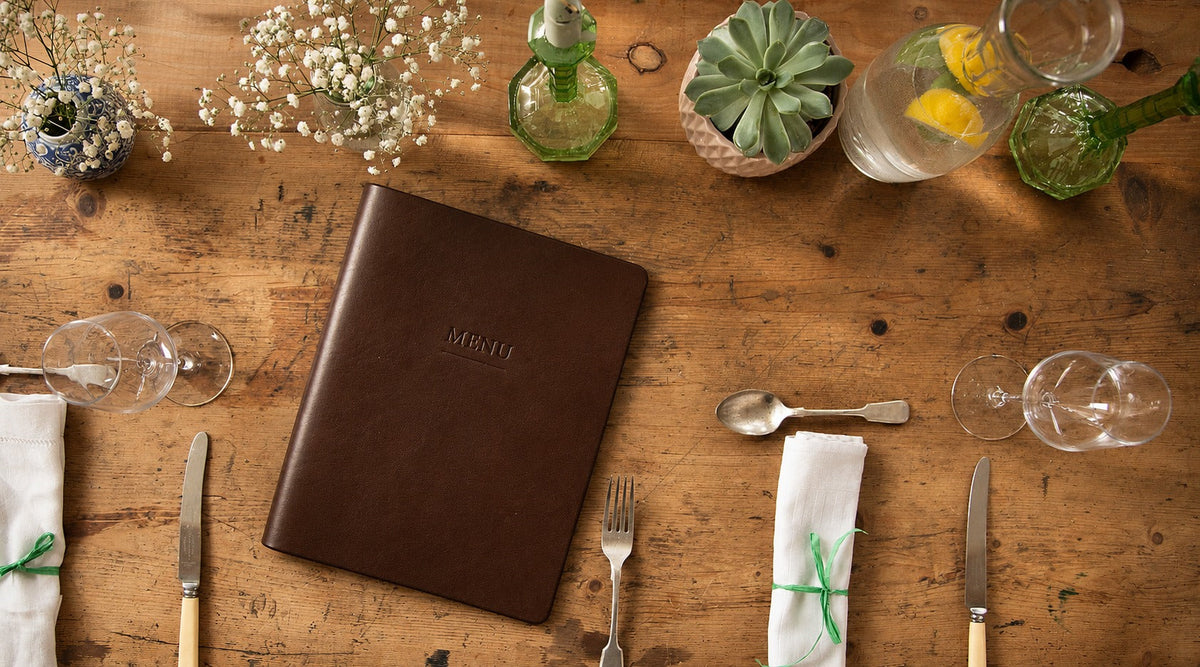
Picture the menu beside a folded napkin, ready for the first guest. You might want a deep brown cover against pale linen, a discreet logo or a generous border around the printed page. Choosing between leather and leatherette menu covers brings another question into that composition. What is the material beneath the surface?
A useful comparison begins there, then moves through ageing, care and the shape of the finished cover. The aim is a piece that belongs in your dining room and suits the way you run it.
What leatherette menu covers are made of
Leatherette usually consists of a textile backing coated with polyurethane, known as PU, or polyvinyl chloride, known as PVC. In PU leather substitutes, the textile base carries one or more polyurethane layers. PVC leather substitutes have a PVC coating applied or laminated to one side of a base material, usually fabric.
Think of the construction in cross-section, with the backing below and the coating above. Both belong in a clear material description. “Leather look” describes an appearance, leaving the composition to be explained separately.

Plasticisers are added to make PVC coatings flexible. These substances are not chemically bound into the material and can migrate out over time. Their role helps explain both the flexibility of the coating and one way it can change with use.
A sample of each material you are considering gives the choice a more personal dimension. Its feel in your hand and its colour beside the menu paper deserve their own place in the decision. Composition explains what you are choosing. Touch and appearance help you decide whether you enjoy it.
What the leather standards mean
The 2022 edition of EN 15987 defines leather as hide or skin whose fibre structure has been made permanent by tanning. The word therefore describes the material’s origin and treatment, beyond the surface pattern you can see.
EN 17651, also published in 2022, addresses descriptions, labelling and marking for leather goods. Under that standard, the description “made of leather” requires at least 80% of a leather good’s outer surface to be leather. The measurement concerns the outside surface of the object.
The standard also says descriptions must avoid misleading claims about species, tanning, grain and finish, and that embossed grain must be identified as an imitation of real grain. These distinctions give a material description useful precision. A preferred colour or grain pattern can sit alongside a clear account of the material itself.
For a commission, the written description and the chosen sample make a useful pair. One records the specification, while the other keeps the intended appearance close at hand.
How the materials age
Ageing is best considered through the selected material and finish, with evidence for the particular changes that matter to your restaurant. A material name alone is too broad a basis for choosing an expected lifespan.
In PVC leather substitutes, continued plasticiser loss makes the coating brittle and can lead to early failure. Plasticiser can leave through evaporation, contact and washing by oil, water or solvents, with heat accelerating evaporation. This explains a process of change without assigning a service life to a particular cover. Among leathers, vegetable-tanned leathers do not match chrome-tanned leathers on heat resistance and flexibility.
Laboratory tests address more specific aspects of wear. ISO 1419 covers ageing tests for coated fabrics, including exposure to heat and humidity. Separate leather standards address colour transfer through rubbing, abrasion, repeated flexing and water spotting.
These are useful subjects for a discussion about performance. Ask any supplier which of these tests its material has passed, and keep the answer with the sample. Let the appearance you would accept after use form part of the brief. There is also an aesthetic judgement to make. How much visible change would feel at home in your dining room, and what condition would prompt you to retire a cover?
Cleaning in daily service
Cleaning should follow guidance for the particular cover and its finish, alongside the requirements of your restaurant’s routine. It belongs in the material discussion from the beginning.
The most useful brief names the products your team uses and the finish being considered. The colleague responsible for looking after the menus deserves a place in this conversation, with room to explain how the proposed cover would fit into daily service.
Before the choice is settled, a cleaning trial on a sample offers a practical point of reference. The aim is a clear routine for that cover, easy for the team to follow.
Styles, panels and page fixings
The printed menu and the way you want a guest to read it should guide the layout of the A4 pages. A food menu, wine list and separate dessert selection give you different layouts to consider.
Lunburg’s leather Menu Cover is a portrait folding design for an A4 menu. It measures approximately 24.4 cm wide by 32.8 cm high when closed, with an A4 insert measuring 21 by 29.7 cm. Its interior panels are lined and edged with narrow leather borders. Its pages are held by visible connecting hardware along the central spine.

A paper outline at those dimensions offers a simple way to picture the object beside a place setting. Within it, try the actual menu text with the spacing you would like around the dishes and their descriptions. Let the page feel as considered as the cover around it.
Review page replacement on the approved prototype with your intended paper. Replacing the pages and reading through them are useful parts of that review. The design decision can then include the work of updating the menu as well as the guest’s experience of opening it.
Our guide to choosing leather menu covers for your restaurant explores the construction of leather covers further.
Choosing the leather and finish for your restaurant
Choose the leather, colour and finish as one composition with the dining room. Lunburg makes leather menu covers in cowhide, calfskin or another selected leather, with smooth, grained or embossed finishes among the choices.
A deep colour beside pale paper offers one direction. A quieter tonal combination, with the restaurant’s name set discreetly near a corner, offers another. The right balance is yours to decide, including how much uninterrupted surface you want around the mark.
Lunburg offers blind debossing, a subtle impression without foil, or foil stamping for the menu cover’s logo. The logo’s position and size can be adapted, with placement and treatment shown in a mockup before production.
Whether you began by considering leatherette menu covers or a particular leather sample, the finished piece deserves to be judged as a whole. Material, care, proportions and lettering all belong to the same choice. Aim for a menu you would be pleased to place in a guest’s hands.
Read more
Choosing a Leather Notebook as a Corporate Gift
Choose a leather notebook corporate gift around the person who will use it, with guidance on sizes, refillable covers, leather and personalisation.
Read more
Company Anniversary Gifts for Staff and Clients
Mark a company milestone with thoughtful gifts for staff and clients, from a useful leather piece to a personal detail that carries the date.
Read moreCreate leather goods for your organisation
Tell us who the piece is for, how it will be used and the quantity you have in mind. Lunburg Corporate Services manages product development, prototype approval, production and delivery.
Explore Corporate Services