
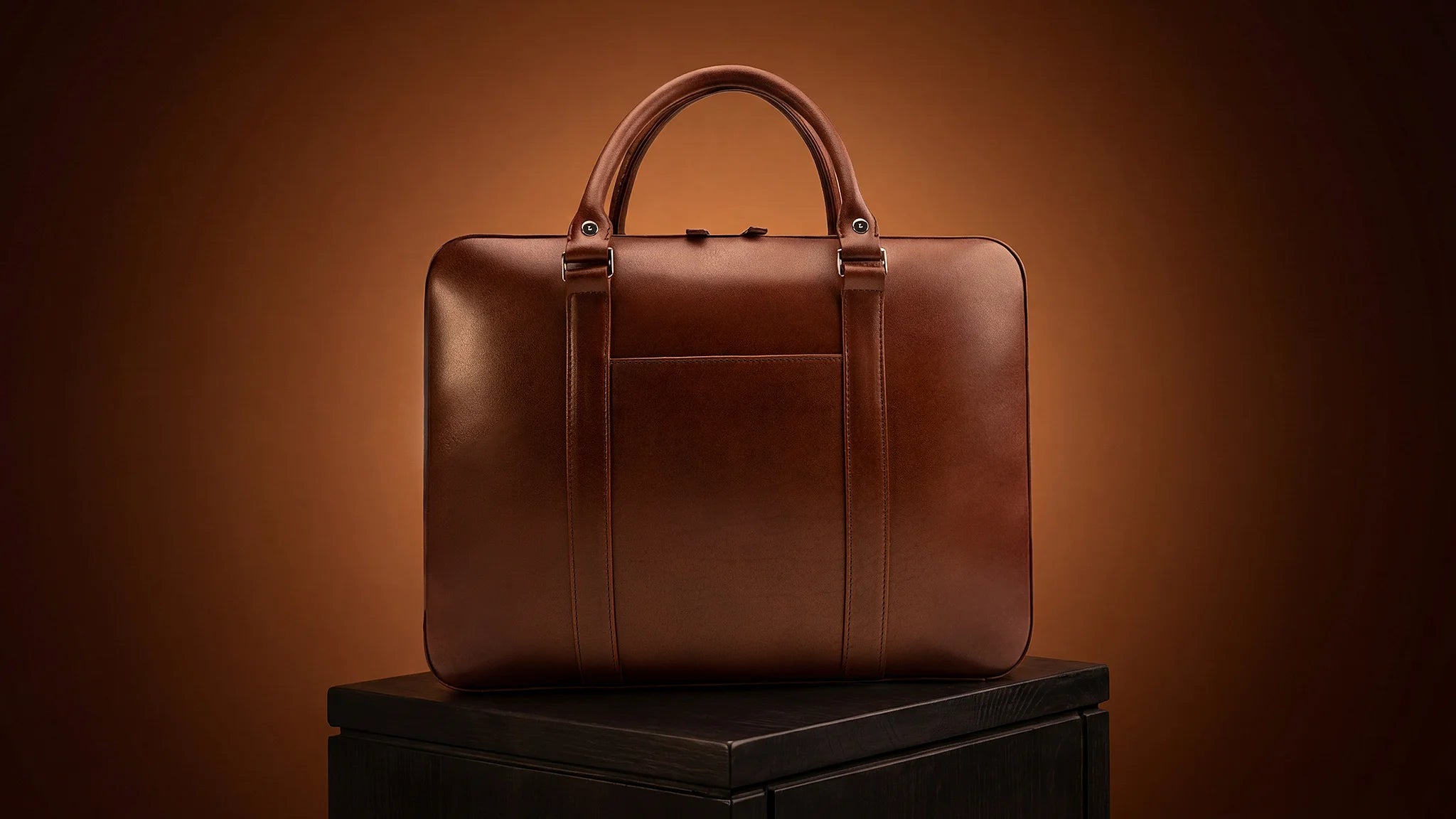
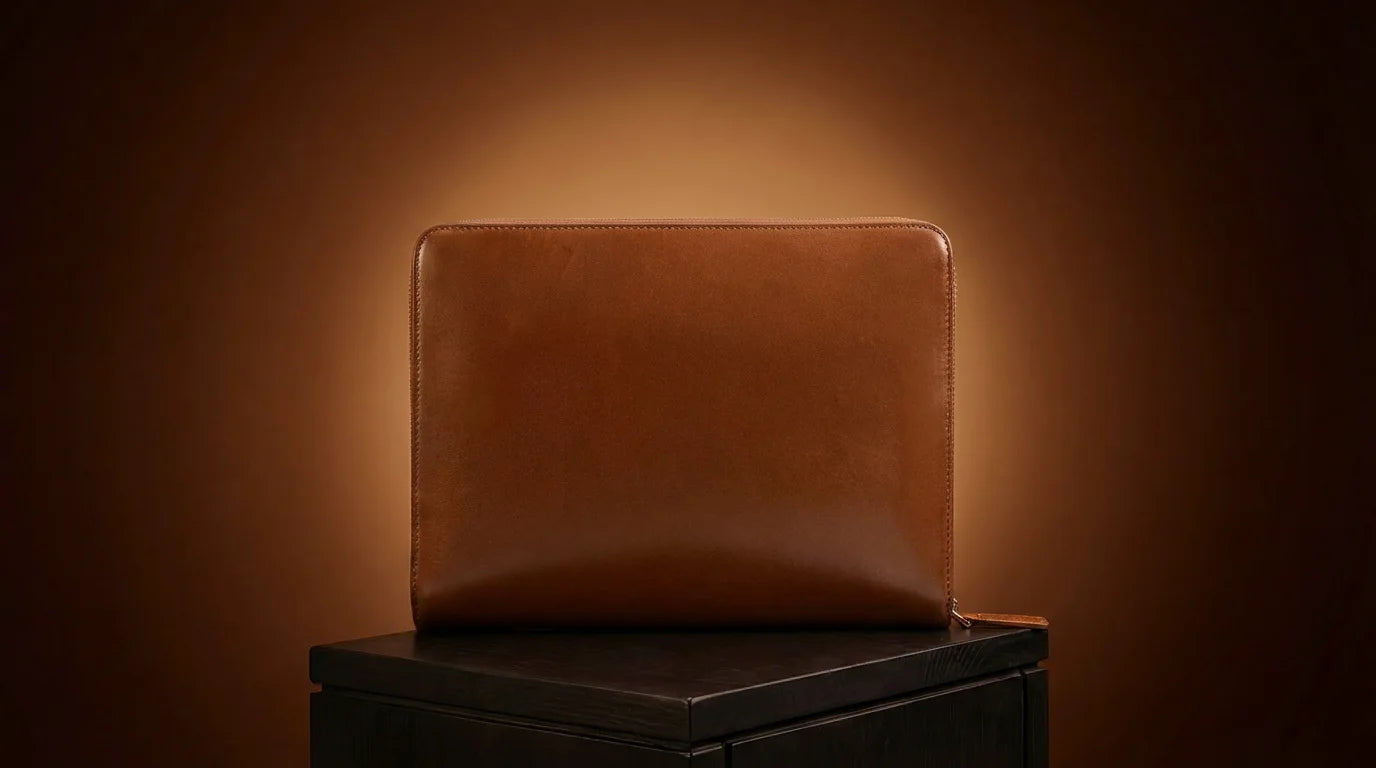
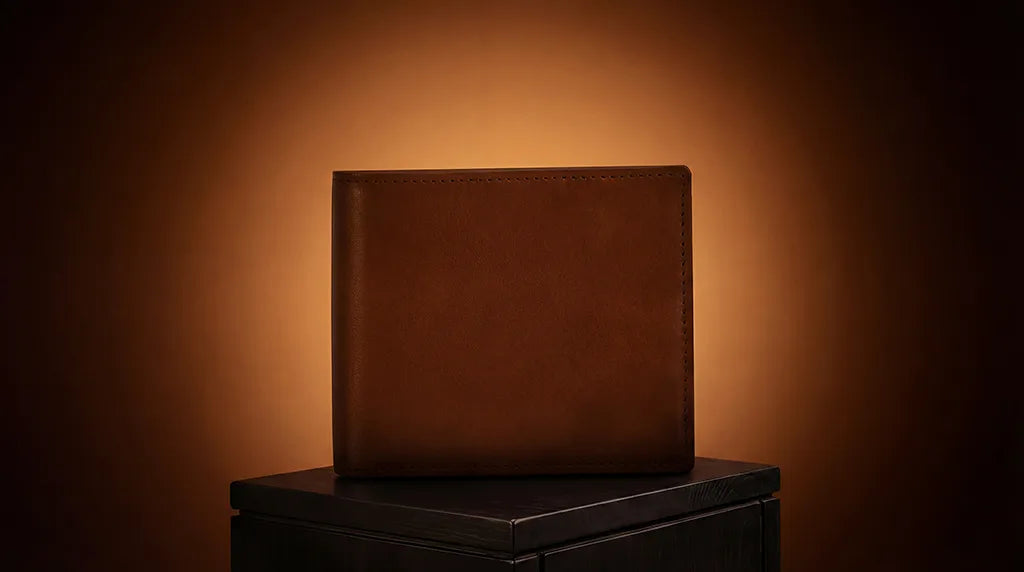


Dossier Portfolio Memoir - Deep Mahogany
Leather Tone


Personalize this piece. Initials, a dedication message, or a family crest. Hand-embossed into leather that carries your mark for generations. Whether for yourself or as a gift honoring a milestone, our concierge will finalize the details with you.
Please note: personalized pieces are realized uniquely to your specifications and cannot be returned.
Current delivery timeline: 3–5 weeks
Description
- - Document Architecture: Dual compartments separate papers by client, category, or chronology. The Compact profile accommodates folded A4 documents, or A5 papers flat. A zipped interior secures what must remain private; six card slots position credentials for immediate retrieval.
- - Continuous Canvas: Constructed from unbroken, single-cut vegetable-tanned leather through the art of Rempliage. The form achieves its quietness through restraint: minimal seams, maximum material integrity.
- - Daily Refinement: This is the Art of Visual Silence: organization elevated into a daily pleasure, engineered to deepen in character with every session.
Craftsmanship Specification
- - Construction Technique: Rempliage
- - Rempliage Length: 865 cm
- - Manual Operations: 283
- - Leather Panels: 33*
- - Reinforcement Panels: 23
- - Forming Technique: Precision Layering on Wooden Forms
- - Stitching Method:
- - Master Artisan Time: 13.0 hours
- - Made in Fes, Kingdom of Morocco
* Large leather surfaces are prioritized; seams minimized. This eliminates failure points and preserves material integrity across decades of use.
Material Composition
- - Hide Origin: Northern Europe, Food Industry Byproduct
- - Tanning Process: 40-Days Vegetable Tanning
- - Finish: Self-Healing Aniline
- - Cut Specification: 2.0mm Full-Grain Double-Bend Vachetta Core
- - Source: 1946 Family Tannery, Tuscany, Italy
- - Hide Origin: Spain, Food Industry Byproduct
- - Tanning Process: Vegetable Tanning
- - Finish: Pigmented Finish
- - Cut Specification: Full-Grain Whole Hide
- - Source: 1950 Family Tannery, Andalusia, Spain
Functional Architecture
- - Perimeter Zipper: A continuous zip encircles the folio, securing documents against displacement during transit.
- - Quick-Access Phone Retrieval: The phone pocket is positioned first from the zipper opening, permitting retrieval with only partial unzipping.
- - Gusset Construction: Integrated side walls maintain document alignment and prevent contents from escaping when the folio is partially open.
- - Dual-Compartment Organization: Two sections separate documents by category, client, or chronology, eliminating the search during presentation.
- - Folded A4 Capacity: Accommodates A4 documents folded to A5 format, or A5 documents flat.
- - Zipped Interior Pocket: A secured compartment protects sensitive documents or valuables from incidental exposure.
- - Six-Card Configuration: Dedicated slots position credentials for immediate retrieval.
- - Business Cards Pocket.
- - Fine Writing Instrument Loop: A generous loop secures pens up to Montblanc diameter.
- - Exterior Proportions: 27 x 20 x 4 cm (10.6 x 7.9 x 1.6 in)
- - Document Compatibility: Engineered for A5 documents flat or A4 documents folded.
Engineered for permanence, this piece is built to withstand a lifetime of movement. This warranty is a partnership in values; together, we reject the culture of the disposable. We guarantee structural integrity for 50 years, honoring an investment in permanence.
Your commission travels to you at no additional cost. All duties and taxes are included; the price you see is final. Should the work not resonate, our 30-day Period of Reflection allows you to return it in pristine condition for a full refund.
Every commission arrives gift-ready: cradled in our signature packaging: a protective dust bag, housed within a rigid presentation case, enveloped in elegant paper, and secured for transit.
Our Inscription service transforms the gesture further; emboss initials, a dedication, or a family crest inside or outside the piece.
- - Enjoy complimentary yearly care sessions covering deep cleaning and conditioning. The specific master artisans who crafted your item will personally inspect it to revive its resilience.
- - We distinguish between the perfection of our craft and the unpredictability of life. While our warranty covers the former, our atelier is dedicated to the latter. We provide indefinite repair and restoration services for non-warranty issues, such as accidental damage or heavy wear. This ensures your investment remains viable, beautiful, and distinctively yours, regardless of where the road takes you.
- - Perpetual Leather requires only a soft cloth for cleaning and clear wax for nourishment. Buff gently with the polishing glove to return the original lustre. For comprehensive protocols, please consult our detailed care guide.
Choose options
Leather Tone

Memoir Collection : The Art of Visual Silence.
A single cut of Perpetual Leather, shaped through Precision Layering on Wooden Forms, finished through the art of Rempliage.

The eye travels across the surface without interruption.
This is Visual Silence. The leather speaks through its grain, its warmth, its scent. Nothing else competes for attention.

The Aide-Mémoire
In diplomatic tradition, the aide-mémoire was not merely a document. It was the instrument that prevented misunderstanding between nations. A summary of discussions. A statement of position. Words chosen with the precision of architecture.
We named this collection for that tradition.

The Single Cut
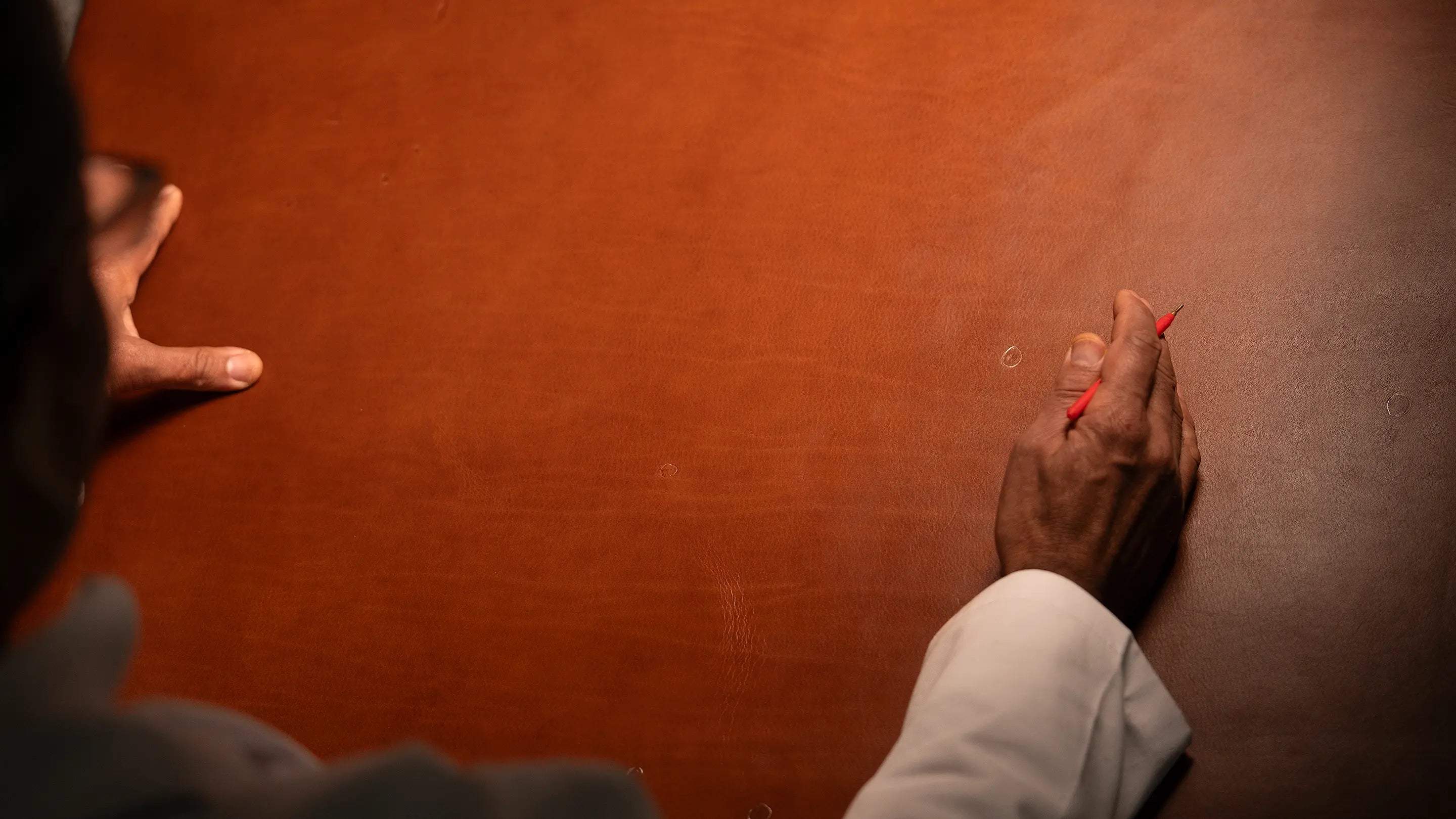
Nature marks each hide with a grain as singular as a fingerprint.
The single-cut philosophy honors this singularity.
The artisan reads the hide, tracing the grain's character with practiced hands, selecting the panel that will become your Memoir.
What emerges is a canvas that belongs to this piece alone.
Sunlight absorbed, touch recorded, a journey documented in the evolution of the surface.
"The Memoir you hold will never exist again."

Precision Layering
The Memoir is among the most demanding constructions in our repertoire.
Beneath the single exterior canvas, multiple layers converge: goat leather lining, reinforcement substrates, protective elements.
Each layer calculated to fractions of a millimeter. Each shaped over wooden forms that impose dimensional memory upon the assembly.
This technique requires twenty to thirty years to master; each of our masters brings over forty.

The result is an object no machine and few masters can produce.
Perpetual Leather
Perpetual Leather is our designation for a material engineered to mature, not degrade.
Sourced from Northern European farms, where cooler climates produce denser collagen structures. Tanned for 40 days in wooden drums at Tempesti, a Tuscan artisanal tannery founded in 1946. Chestnut and mimosa extracts build resilience that chemical processes cannot replicate.

We select exclusively from the double-bend core, the most coveted section of the hide. Full-grain 2.0 mm Vachetta. Nature marks each hide with a grain as singular as a fingerprint. No two pieces will ever be alike. The surface is satin, warm to the touch, carrying the clean scent of bark and time.

The Fifty-Year Warranty
A fifty-year warranty is our philosophical position on permanence.
Our first instinct is always to mend, never to replace, so your patina endures.

Our Philosophy
A Dutch-Moroccan, our founder carries two inheritances. From one: the discipline of functional design, honed across fifteen years in engineering. From the other: a childhood spent among the ateliers of Fes, where his family has worked since 1968.
Amien Marghich's position as insider to the craft and outsider to fashion defines our orientation: technical rather than trend-driven, permanent rather than seasonal.
Our signature is the object itself, not a logo. Design conceived to remain as relevant in fifty years as it is today.
Forty percent of profits return to preserve and expand the craft. This is not philanthropy. It is necessity.
The art of Rempliage is endangered. It is used in fewer than one in 10,000 leather goods made globally. Mastery requires twenty to twenty-five years of practice. Without intervention, the current generation of masters may be the last.
When you commission a Lunburg, you become a patron of this art.
Common Questions About the Memoir Collection
The Memoir collection is not a product range. It is a system. Every piece is built on the same construction principle: a single, unbroken cut of Perpetual Leather, finished through Rempliage, with no seams interrupting the exterior surface. What varies is the specific work each piece is designed to support.
The collection organizes naturally around the three modes of professional work:
Device-driven work is served by the Workstation Portfolios, the Laptop Sleeves, and the Tech Organizer: pieces that protect and carry technology in sessions that range from a tablet meeting to a full laptop workflow.
Document-driven work is served by the Dossier Portfolios and the Documents Folder: pieces organized around paper, from internal working sessions to formal presentations where documents must arrive flat and undisturbed.
Analog work is served by the Notebook Covers and Atelier Case: tools for the notation and instrument management that runs alongside both.
Selecting a combination begins with identifying which of these three modes defines most of your day, and whether your briefcase already handles the others. Many patrons commission a primary folio for their dominant work mode and a notebook cover as the constant companion across all three.
Beyond dimensions, the two pieces share the same internal architecture: padded device compartment, removable notebook attachment, dual pen loops for stylus and writing instrument, business cards pocket, cables pocket, and quick-access phone retrieval. The organization does not change between them. The scale does.
The Workstation is sized around a tablet and an A5 notebook. The Grand Workstation is sized around a 13-inch laptop and an A4 notebook. Neither folio is configured to carry both simultaneously.
For a patron who carries both devices daily, the Opus briefcase provides the natural foundation: a dedicated padded laptop sleeve and sufficient organization to carry the tablet, accessories, and documents within a single structured carry. The Workstation Portfolio then serves a distinct and complementary purpose: for sessions where the laptop stays at the desk and the tablet leads the work, it provides a complete, self-contained carry without the weight or presence of the full briefcase. The two pieces do not overlap. They address different modes of the same working day.
The right Memoir portfolio begins with an honest account of how you work.
The Grand Workstation Portfolio suits the professional whose day is built around a laptop and a full notebook. Product managers conducting user research across co-working spaces. Management consultants moving between client sites with slides and models open throughout the day. Strategy directors who write, present, and analyze within the same session. Academics who lecture, annotate, and draft in a single carry. Any role where the laptop is the primary instrument and a physical notebook runs alongside it.
The Workstation Portfolio suits the professional for whom a tablet is a complete work device. UX designers and creative directors who wireframe, annotate, and present from an iPad Pro. Architects and engineers who sketch, mark up plans, and review drawings in the field. Sales leads and business development professionals who present proposals and capture notes in client meetings without requiring a keyboard. Educators and consultants whose workflow is visual, stylus-led, and meeting-intensive.
The Grand Dossier Portfolio suits the professional whose work lives in full A4 documents that must arrive unfolded. Corporate lawyers, notaries, and M&A advisors who carry contracts, term sheets, and agreements between signings. Investment bankers presenting pitch decks and financial summaries to clients. Real estate professionals presenting sales agreements and property documents. Any role where the quality of a document's presentation carries professional weight.
The Dossier Portfolio suits the professional whose document carry is substantial but does not require full A4 presentation. Management consultants carrying internal working documents between meetings. Financial advisors reviewing folded client reports. HR directors managing employment contracts and compliance documentation across multiple sites. The distinction from the Grand Dossier is not importance but format: folded A4 serves the working session; flat A4 serves the presentation.
The Laptop Sleeve suits the professional whose carry reduces to a device and nothing more. Software engineers and developers moving between desks and meeting rooms with nothing but their machine. Data analysts and quantitative researchers whose entire workflow lives in a terminal and a browser. Technology executives who attend meetings without paper, without a notebook, and without accessories beyond the laptop itself. The carry is minimal by deliberate choice, not constraint.
The covers were designed to remain open to the patron's preferred notebook rather than prescribe one. The A5 format (148 × 210 mm) and pocket format (90 × 140 mm) are widely observed standards, and Leuchtturm1917, Moleskine, and Midori all produce notebooks within these dimensions. Any of them will fit. The interior sleeve receives and releases refills without adjustment, so replacing a finished notebook requires no reconfiguration of the cover.
The only relevant variable is the notebook's own construction. The sleeve is designed for notebooks with a soft, thin cover. A rigid hardcover or a heavily padded binding will not seat flush and may affect the clean closure of the folio.
The construction time reflects two compounding demands that no conventional leather portfolio encounters.
The first is Rempliage. Where painted edges permit misaligned borders to be trimmed flat and concealed, Rempliage requires absolute geometric precision from the first cut. Each edge is skived through multiple passes to a 0.1 mm (0.004 in) tolerance, folded irreversibly, and set with a hammer calibrated to the specific temper of the hide at that moment. On the Workstation Portfolio, this sequence extends across every edge of a multilayer assembly, where four to six layers of exterior leather, lining, and reinforcement substrates must converge and compress without accumulation, each calculated in relation to those around it.
The second is Perpetual Leather. Unlike dimensionally stable conventional leathers, it breathes continuously throughout crafting, responding to humidity, temperature, and the sustained pressure of the artisan's hands. A painted edge absorbs and trims away these constant dimensional movements. Rempliage requires the artisan to read and guide the living material at every stage, adjusting the fold and the hammer stroke in real time across the full construction. Eleven hours is what that sustained, uninterrupted precision costs.